CALIPERS TO A CUSTOM PIN BRIEF
5-dimension custom load pin configurator.
Use one unit throughout. Enter the pin diameter, loaded length, tongue width, outer lug width and shear-groove spacing. Include the fit tolerance and full pin length in your sketch.
THE FIVE-DIMENSION BRIEF
Your existing pin is the starting point.
Measure D / L / A / B / C or attach a sketch. We review the joint, load cases and interfaces before releasing a drawing or quotation.
- D
- Pin diameter and fit
- L
- Overall loaded length
- A
- Center loading tongue width
- B
- Each outer clevis lug width
- C
- Shear-groove center spacing
L describes the loaded span here. Include the overall end-to-end length, asymmetric lugs, spacers and retention details in your drawing or notes. Five values start the review; they do not fully define a production pin.
Download sizing sheet ↓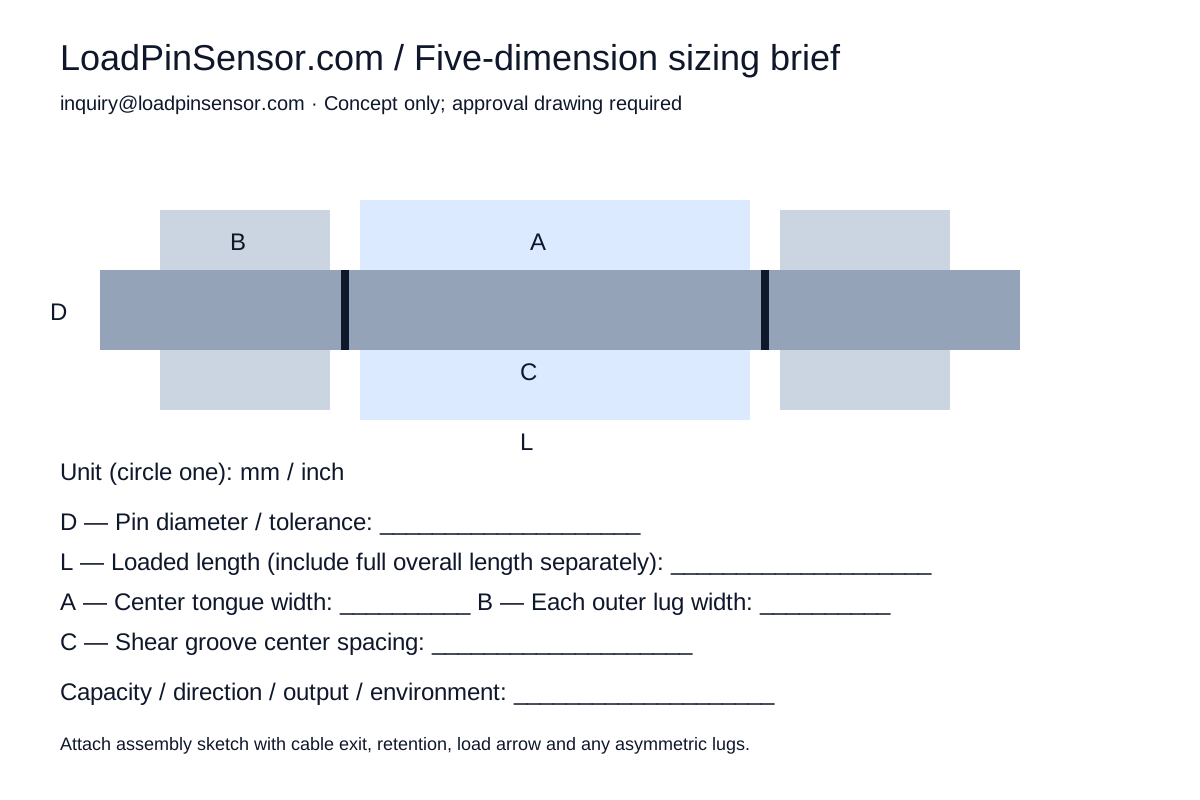
BEFORE THE DRAWING REVIEW
Fit, force and delivery: what to confirm.
Can a load pin replace a plain steel pin without structural changes?
A custom measuring pin can be designed around the existing bore and load path. Keeper mounting, cable clearance, contact widths and load orientation still need review. Zero structural modification is a design objective, confirmed against your assembly.
Can I request just one custom pin?
Yes, request a single prototype. We confirm material, geometry, test scope, any engineering or tooling charges and unit price in a written quotation.
Is the five-dimension form enough to manufacture a pin?
It starts the engineering review. Fits, full overall length, asymmetrical lugs, contact details, load direction, retention and electrical requirements must be confirmed on the approval drawing.
How do I request a 10-day delivery or a STEP drawing?
Include your required delivery date and destination. A two-hour drawing response, 10–12-day dispatch and no-tooling-fee options are commercial targets requiring configuration and capacity confirmation; they are not universal lead-time guarantees.
Does IP68 cover seawater at any depth?
Specify depth, time, pressure cycling, connector state and seawater exposure. A configuration-specific immersion qualification is needed. Wireless transmission is assessed separately.